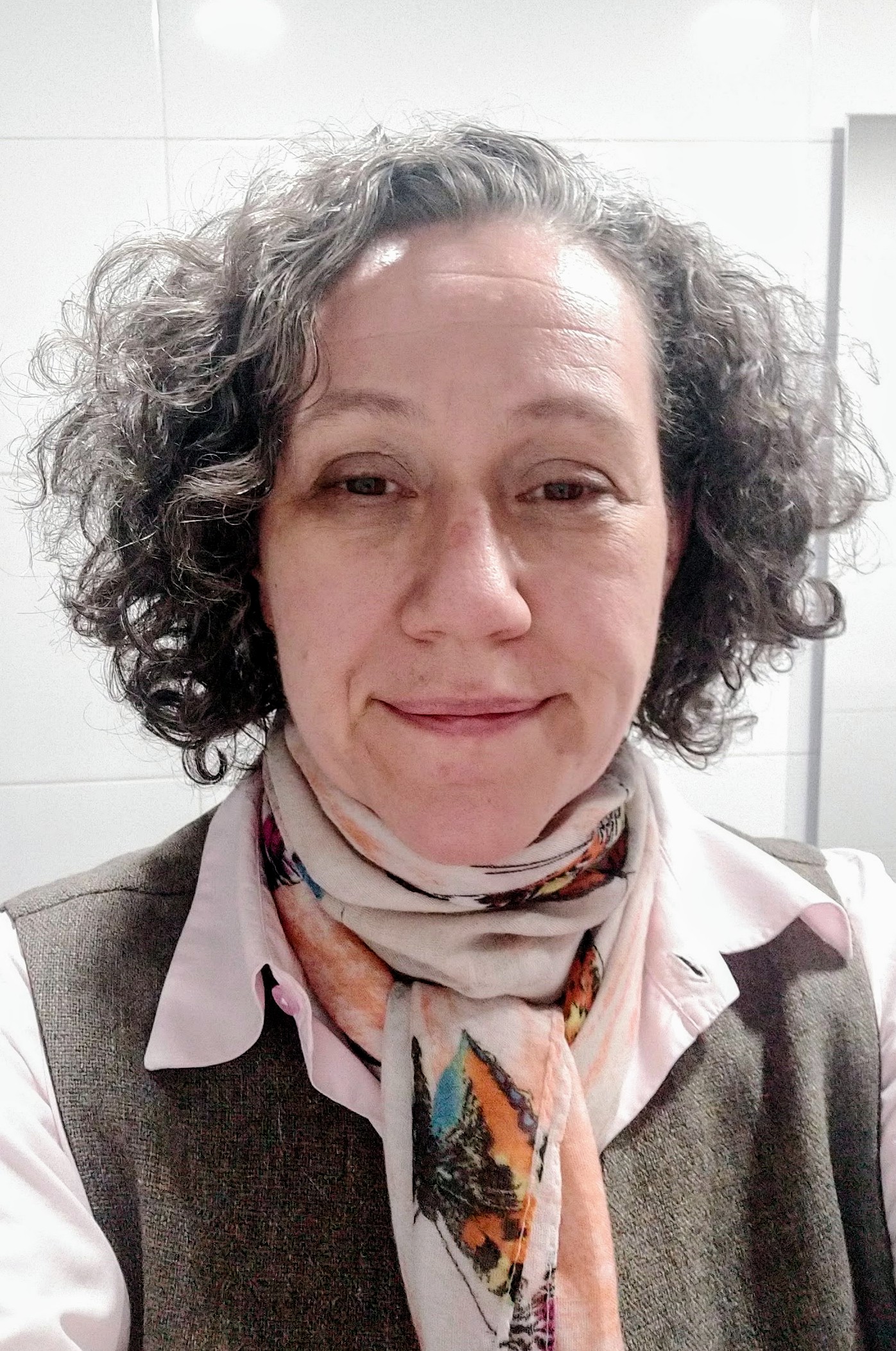
Katharine N. Farrell
Universidad ECCI, Colombia
Biography
Katharine (Kate) is Member of Pi Sigma Alpha, the Political Science Honor Society of the United States, holding a BA (with honors) in Political Science, with studies in biochemistry, two MSc degrees, one in Urban Policy Analysis and Management (with honors) and the other in Environmental Engineering (by research), and a PhD in Ecological Political Economy. She is an alumnus Marie Curie Intra-European Fellow and completed her Habilitation in Resource Economics in 2018, with the Life Sciences Faculty of the Humboldt Universität zu Berlin. She is lead author of over 20 high impact academic articles concerning ecological economics, environmental governance, sustainability, Wicked Problems, and the complexities of life and has led the production of several high impact edited collections and research projects. She has worked as a senior researcher and/or lecturer at universities throughout Europe and in Asia and the Americas and is currently a staff lecturer with Universidad ECCI (Escuela Colombiana de Carreras Industriales), a member of the research group GEAAD - Grupo Economía, Ambiente y Alternativas al Desarrollo of the Universidad Nacional de Colombia and an adjunct postgraduate supervisor with the Centro Interdisciplinario de Estudios sobre el Desarrollo, of the Universidad de los Andes, Colombia.
Sessions
Don’t shoot the cat!
Designing global governance has been a topic at least since 1955, when broached in the Russell-Einstein Manifesto on nuclear disarmament. Despite many subsequent attempts, results have been woeful and the world is presently charging full speed into planet level ecological collapses and a global phenomenon of ideologically aligned factionalized authoritarianisms. We approach this as a classic problem of variety management and propose that Beer’s Viable System Model (VSM) offers a way to design democratic world governance that handles both current globalized socio-ecological variety and the world’s rapidly increasing capacity to create variety. We start from the observation that authoritarianism, by right of its basic character, has a very dysfunctional way of managing variety: its reflex is to shoot the perturbation - the cat. Unfortunately for authoritarianism and those subjected to it, environmental perturbations and responses to them are a prerequisite for creativity, which is central to a VSM’s adaptive capacity. Apart from Beer’s work, our position is supported by three pillars - 18th Century and contemporary federalism theory; Nobel laureate Ilya Prigogine’s work on self-organizing systems; Vincent and Elinor Ostrom’s work on polycentricity. This theoretical framework is enriched through reference to applied cases of corporate and cooperative management. We argue that authoritarianism brings societies’ variety down to levels that preclude the ability to deal with global problems. Using Prigogine's insight that far-from-equilibrium system regulation follows situation-specific rules, we demonstrate how authoritarian responses to situational-variety reduce operational-variety while increasing the variety of global problems, making effective response more difficult. We then argue that federalism does precisely the opposite - fostering operational autonomy while placing localized responses to localized situations at the disposal of the global system. E. Ostrom argues that policies required to deal with the climate crisis will vary significantly, in order to match the variety of scale and ecosystem. We concur. However, we examine the suitability of applying polycentricity uncritically within a Laisse Faire capitalism context. Combining V. Ostrom’s work on polycentricity with federalism and Prigogine, we treat global governance as a far-from-equilibrium system and propose that, while it may achieve moments of stability through authoritarian dynamics, democracy is needed to achieve governance that is both viable and effective and also humane and just.
Purposive AI for the 21st Century Sustainable University
Universidad ECCI (Escuela Colombiana de Carreras Industriales – U-ECCI) is a Colombian technical university founded in the 1970s with expertise in electronics, robotics and control-systems design, where developing and operating models is a core competence. After transitioning, in 2014, from technical school to university U-ECCI is now pivoting from expertise-based Faculties to purpose-driven Schools. To support this work, an interdisciplinary team is guiding deployment of the Artifical Intelligence (AI) system, NousECCI, constructed on Anthropic's Claude, which models university operations using a combination of Stafford Beer's Viable System Model (VSM) and Robert Rosen's Modelling Relation (RMR). The School of Sustainable Productivity serves as our map. NousECCI runs the VSM as a living model: with a knowledge graph refreshed daily from institutional databases, agent-based modelling of subsystems, and algedonic signalling. The RMR reframes the VSM management-operations relationship as an encoding/decoding commutation problem, resolving a programming loop problem and yielding a measurable, dated metric of commutability between its model of operations and operations being modelled. NousECCI is an active, non-human participant in the collaborative dynamic programming project dedicated to its development and utilization. Here we examine work-in-progress across five axes: (i) collaborative dynamic programming, with the AI treated as a development-team member, with contributions documented through CRediT roles, while humans retain accountability; (ii) ethics, where machine authorship and responsibility on the table for discussion; (iii) living-system dynamics, viability and biology as guiding principles, with wake/sleep cycles for NousECCI, homeostatic pruning of ungrounded hypotheses, where process based sustainability for AI and the university are design goals; (iv) effective, ethical, responsible and sustainable university governance under ISO standards and Colombian regulation; (v) AI supported pedagogy for sustainability. We close with reflections on lessons learned, milestones and challenges, and projection of where this work could lead, as contemporary cybernetic practice focused on sustainable organizational design and practice.