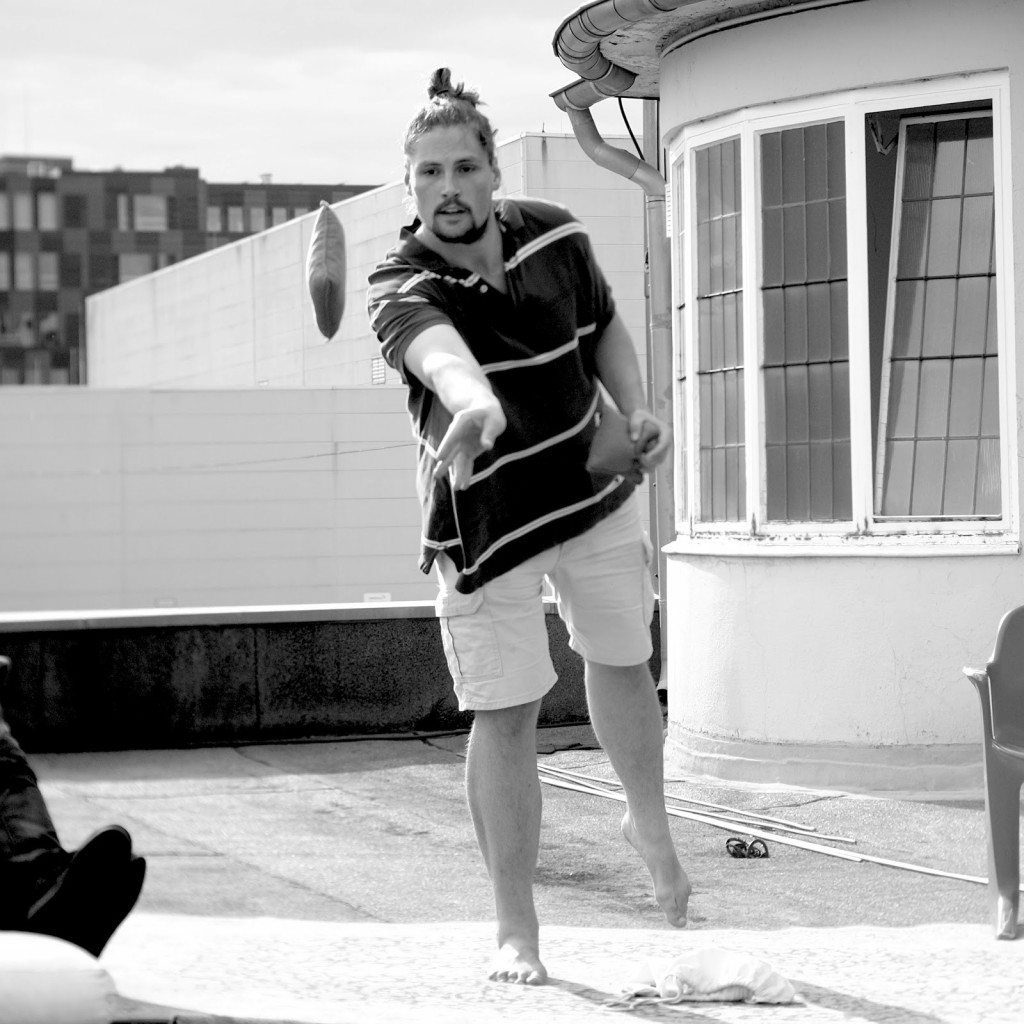
Sascha Kullak
Biography
Sascha Kullak is an independent practitioner of applied cybernetics, working at the intersection of urban development and organisational self-governance, based in Münster, Germany. Since 2015, he has co-founded and co-governed B-Side Münster — a commons-public-partnership cultural centre developed through ten years of lived self-organisation. From 2019 to 2024, he orchestrated Hansaforum Münster, a federally funded model project for democratic neighbourhood governance. It was during this time that he became painfully aware of the lack of a self-organisation system as simple to apply as it is potent in effect.c He holds an M.A. in Nonprofit Management, with a thesis on the transfer of Christopher Alexander's Fundamental Differentiating Process to non-profit organisations — which was also the scholarly birth of his heart project: a VSM-based serious game that puts the power of self-organisation into as many people's pockets as possible. He currently works as 'common good officer' (for lack of a better translation) at the Montag Foundation Urban Spaces in Bonn, where he enables a public-interest concept-based tender process for the allocation of real estate to the best idea instead of the highest-bidder.
Sessions
Gamifying the VSM
HEX-VSM — an idea for a serious game. 'How do we shape our organisations so that they heal us more than they harm us?' That question has been with me for more than ten years. For about three of them I have been convinced that a serious game based on the VSM, played on a smartphone, is part of the answer. Two claims are central to it. First, the explicit introduction of health as a phenomenon into the VSM, by way of Antonovsky’s concept of salutogenesis. His sense of coherence is made up of three components: comprehensibility, manageability and meaningfulness. For individuals it is well researched. In the game it is joined by the organisation’s why — System 5 — as a shared point of reference, so that members can set their own experience of meaningfulness in relation to something larger than themselves. Second, the complexity behind each of the five abstract systems, and behind their interplay, is not taught from the front of a classroom but conveyed through play. This follows the emancipatory ambition of Angela Espinosa’s Self-Transformation Methodology: to put cybernetic knowledge and tools into the hands of the people who are themselves affected by their organisation’s decisions, so that a learning organisation can grow out of it. “Easy to learn, hard to master” is the design philosophy by which the five systems are turned into interlocking minigames. On the board, players map their own organisation, and in doing so they link their mental models into one shared form — a boundary object, to put it in scientific terms. This emergent, interactive form should let them understand better how their organisation works, and show them where their own room for manoeuvre and their own possibilities lie. So that at the end of a working day they can drop onto the couch with the unbeatable feeling of having moved something meaningful forward. What drives me is the conviction that the VSM holds enormous potential for the everyday lives of very, very many people — and that, with its high level of abstraction and the aesthetic air of a circuit diagram, it partly stands in its own way. I therefore welcome the idea of a barefoot cybernetics whole-heartedly, and this concept is my contribution to it. A testable prototype does not exist yet, but it should come into being over the coming year. What awaits you in this talk is therefore the exposition of an idea — one that would very much welcome constructive criticism of every kind afterwards.